Local party websites contain detailed information about local organizations, but they are a difficult source for historical research. Formats differ across chapters, pages disappear, and many sites were not archived consistently. CLARA uses archived versions of these websites to build an annual panel of 2,635 local chapters of the seven main German parties from 2015 to 2026, for a total of 31,620 chapter-years. The unit is the Kreisverband, the county-level organization of each party.
How the data were built
I reconstruct each chapter's website separately for each year using Internet Archive snapshots. The release draws on about 1.03 million archived pages. The 2026 wave combines archived snapshots with a live crawl of the same websites conducted in August and September 2026, which adds roughly 89,000 pages. A locally hosted open-weight language model extracts structured variables from these pages. No commercial model was used to produce the released data.
For news pages, duplicate archived versions are collapsed to one record per article. The resulting file contains 278,638 articles dated between 2015 and 2026. Each article is classified by policy topic, function, and geographic focus. The data report documents the sampling frame, website discovery, and extraction procedure.
What the data measure
- Organizational presence: whether a board, officials, issue content, and a local office address are listed.
- Board composition: size, gender shares inferred from first names, whether a chair is listed, and proxies for professionalization.
- Issue emphasis: 25 topic families mapped to the Comparative Agendas Project scheme.
- Digital presence: the chapter's own accounts on six social platforms, excluding national party accounts.
- Mobilization infrastructure: whether the site provides a way to donate, join the party, subscribe to a newsletter, view a program or events, or volunteer.
- News content: article counts and shares by topic, function, and geographic focus.
Coverage and limitations
Coverage is not random. Of the 27,828 chapter-years in the recommended analysis scope, 20,050 are usable. About 23 percent have no Internet Archive snapshot for the relevant year; those observations cannot be recovered. The panel includes source and coverage indicators, so users can impose stricter coverage requirements. When an archived page of the relevant type exists, extraction almost always succeeds.
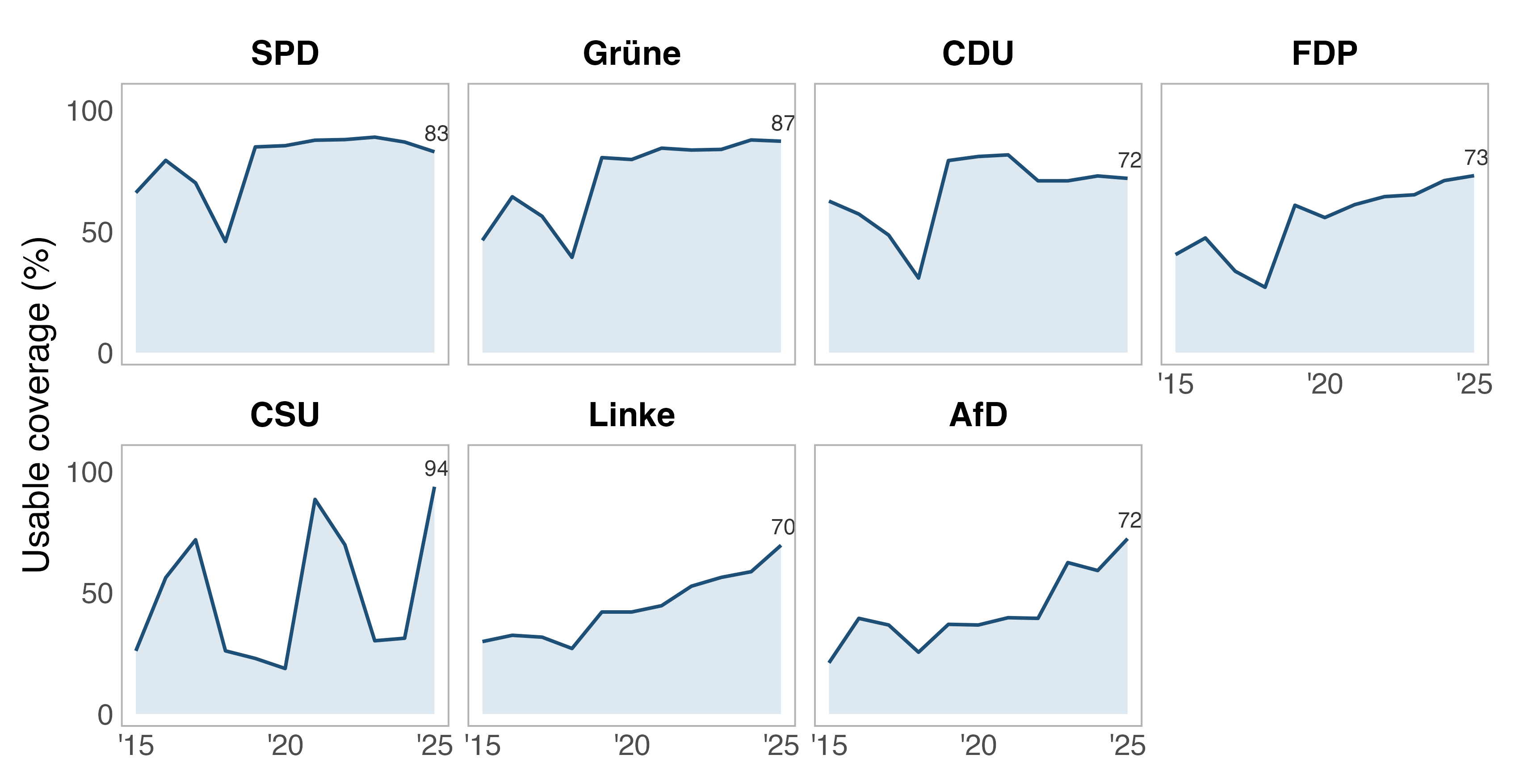
Selection enters at two points. The roster was assembled from chapters whose websites were still online in early 2026, so chapters whose websites disappeared before then are absent from the dataset, especially in the earlier years. Within the roster, a chapter is observed in a given year only if the Internet Archive captured its website that year. In 2026 the live crawl observes every site that answered, so that year is the most complete in the panel.
These gaps matter most for news counts. A low count can mean that a chapter posted little, that the Internet Archive captured little, or both. I would therefore treat comparisons across chapters and multi-year averages as more reliable than annual changes within a chapter. The codebook identifies the variables that describe coverage.
Validation
I manually compared extracted records with their source pages in five stratified samples. In the sample drawn directly from the released records, 45 of the 46 decidable records were confirmed. As a separate check, a second open-weight model from a different model family evaluated a new sample against the source pages. The deposit reports the results of both checks.
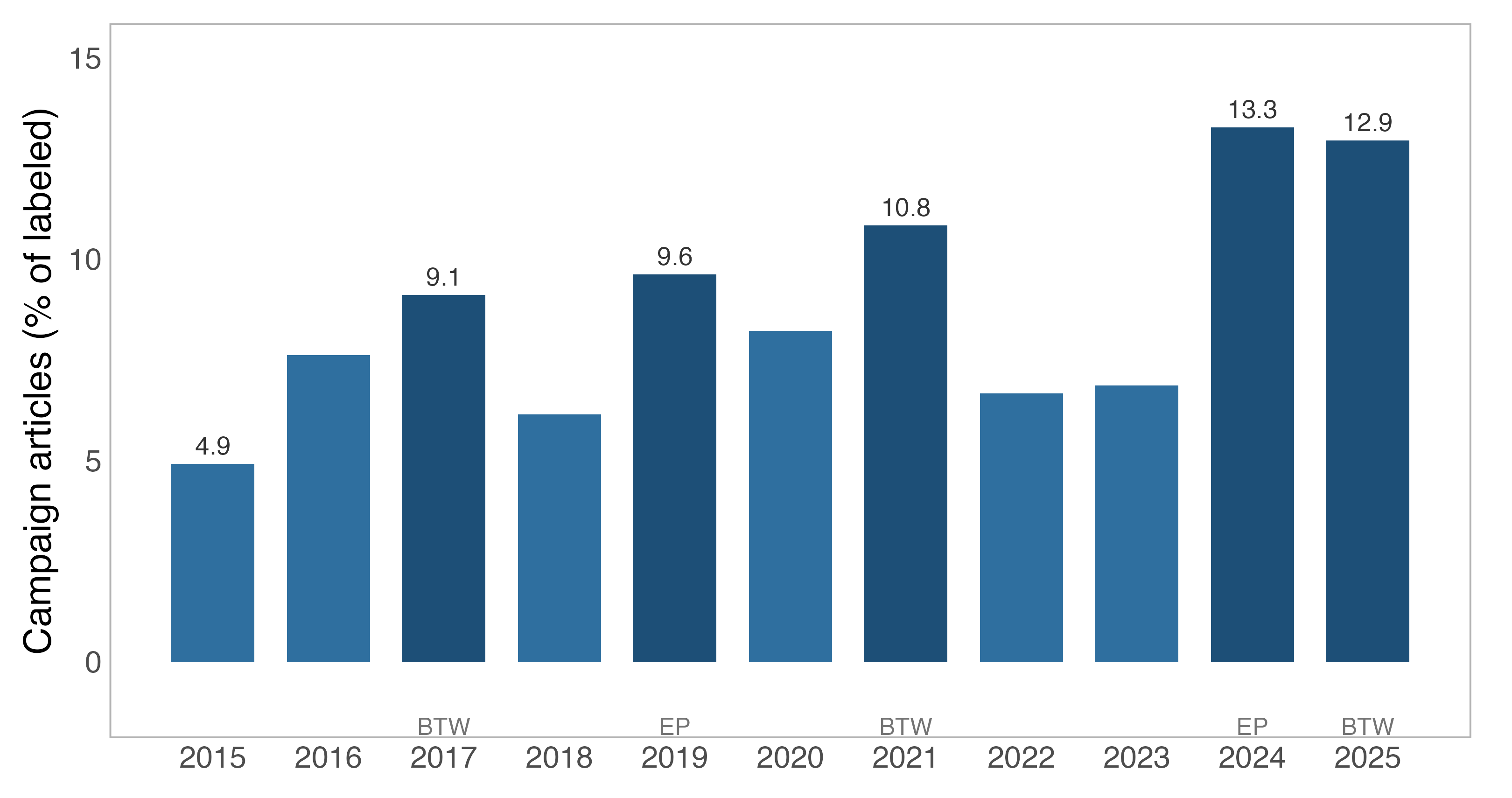
The classifier does not receive the year as an input. Nevertheless, the share of articles classified as election campaigning rises in federal and European election years.
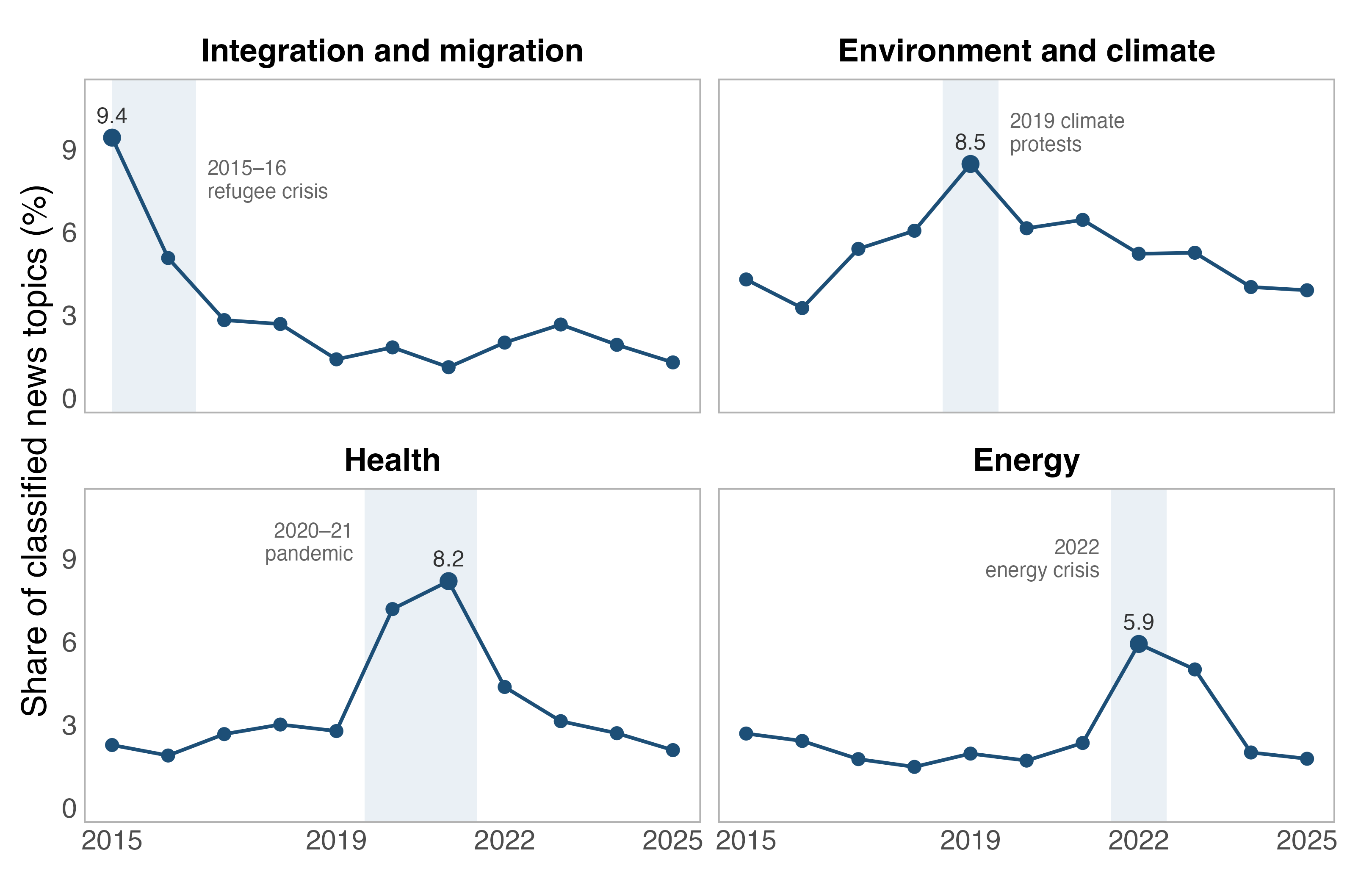
The topic series also track major events. Migration, climate, health, and energy reach their highest or near-highest levels of attention around the refugee crisis, the 2019 climate protests, the COVID-19 pandemic, and the 2022 energy crisis.
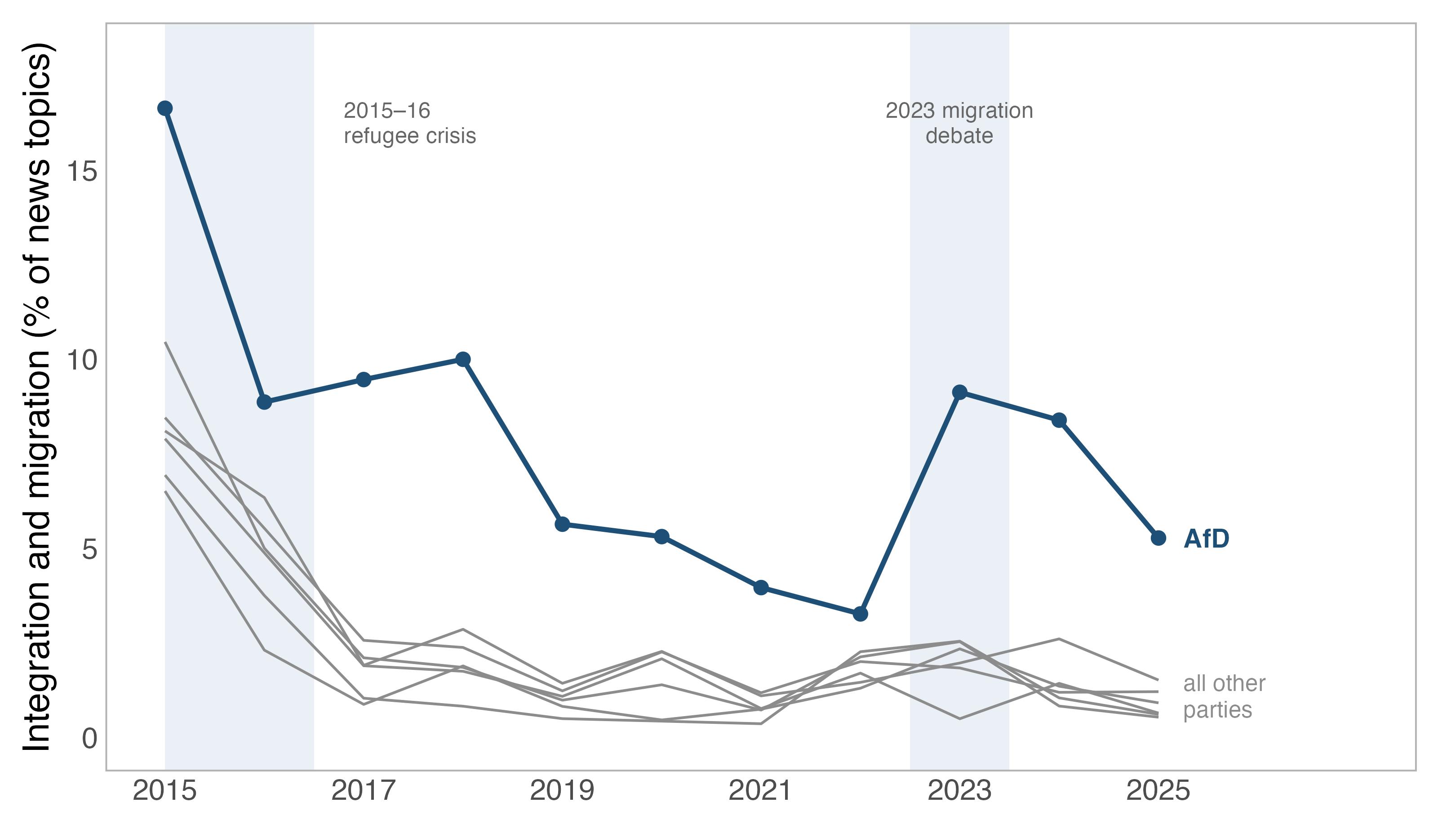
Parties differ as well. In every year from 2015 to 2026, migration accounts for a larger share of AfD news topics than of any other party's.
Data and documentation
The Dataverse deposit contains the chapter-year panel and its enriched version, the chapter roster, long-format topic and news files, a per-row provenance file, and crosswalks to the Comparative Agendas scheme and Bundestag electoral districts. It also contains the codebook, data report, coverage diagnostics, validation summaries, and minimal R and Python load scripts. The core panel is mirrored here as chapter_year_panel.csv (15 MB). The Harvard Dataverse deposit is the citable version.
The public release excludes person-level records and page text. The records are personal data under the GDPR; the text was written by the parties and may be protected by copyright. A controlled-access version of this material is in preparation. Data and documentation are CC-BY-4.0. Pipeline code is available from the author on request.
Citation
Hilbig, Hanno (2026). CLARA: Communication of Local German
Party Associations, Recorded Annually (2015-2026). Version 1.1.0.
Harvard Dataverse. https://doi.org/10.7910/DVN/2KJSCO